Why this blog?

To understand why this blog was created and where it got its name, start here
Showing posts with label oysters. Show all posts

Saturday, July 4, 2015

A Remembrance of Francis Dubourg

I have lost a very dear friend.

Francis Dubourg, owner of La Cabane à Huîtres in Paris, passed away after a long battle with cancer on February 28th, 2015.

Francis was a larger-than-life character, a man with a booming voice, charming accent, and welcoming smile who made each patron of his tiny 16-seat establishment feel at home. I discovered the Cabane in March, 2010, shortly after I arrived in Paris alone. I love the briny sea taste of raw oysters and found the Cabane à Huîtres in a Google search - surprising because Francis never owned a computer and never created a website. But patrons found him, and his business grew mostly on the basis of word-of-mouth.

The Cabane became a second home for me. I went there every week -- sometimes even twice in the same week -- usually at lunchtime with the other regulars, leaving the evenings for tourists. I knew most everyone by name - including Mr. Pons who at 96 years old attributed his longevity to eating oysters and never drinking water!
Francis with Mr. Pons
I celebrated my 60th birthday at the Cabane a Huitres. I invited several friends, including Eleanor Beardsley, NPR Paris correspondent who did a story about Dubourg's oysters. You can listen to that story here. The highlight of my birthday party was a 60-year-old bottle of wine that Francis opened for the occasion. It was still drinkable! You can see photos from my birthday celebration here.

My oyster obsession didn't stop at the Cabane in Paris; Francis invited me to come to Arcachon where I was lucky enough to visit the oyster beds and watch the Dubourg family at work. You can read more about that trip here.

I started dating while in Paris, and the litmus test for any potential partner was: did he like oysters? and did Francis approve? A couple of dates didn't pass the test. Patrice did. We celebrated Frédéric's birthday at the Cabane with friends, family, dozens of oysters and lots of champagne. Later Francis invited Patrice and me to visit the Arcachon oyster park again.
Francis' grandson Théo, son Frédéric, and Patrice
Francis loved the United States and he loved rock and roll music. He had a great baritone singing voice and sounded just like Elvis Presley whose songs he knew by heart. His idol, however, was Buddy Holly. He dreamed of following Route 66 and of visiting Lubbock, Texas to see Holly's birthplace and final resting place. Perhaps it's just as well he never made it - he might have been disappointed.

I miss Francis. He leaves behind his 92 year old mother, his wife of almost 50 years, Regine, his son Frédéric and two grandchildren. The Cabane à Huitres is not the same without him. I fear it will close for good, the end of an era.

Sunday, April 27, 2014

Oysters

This rainy Saturday morning we went the rue de Lévis to pick up some oysters and to chat with Frédéric Dubourg, son of my dear friend Francis, owner of la Cabane à Huitres. Francis has been battling cancer for the last 18 months and has not been well enough to leave his home on the Arcachon basin near Bordeaux. Business at the Cabane has suffered in his absence, as Francis is the heart and soul of the tiny place.

However, the oysters are still delicious, and Francis' son Frédéric makes the trip from Arcachon to Paris each week to sell oysters in the rue de Lévis market on Saturdays and Sundays.

Most people buy the tasty mollusks to take home, but Frederic also has a faithful group of clients who come each Saturday at 1PM equipped with bottles of Muscadet to sit and chat while enjoying a plateau of the briny treasures accompanied by several glasses of wine.

I was lucky enough to visit the oyster beds where these are grown. You can read more about that adventure here.

Monday, December 26, 2011

Réveillon de Noël

The traditional French Christmas eve dinner (réveillon de noël) gathers friends and family around a table that often includes oysters, foie gras, champagne and other delicacies.

Patrice and I were invited to réveillon at the Cabane a Huitres. It was a private dinner with Francis, his wife Régine, son Frédéric and a couple of family friends. Dinner included champagne and plenty of oysters - of course!

Monday, July 11, 2011

Oyster beds

Last August I visited the oyster beds of Arcachon with Francis and Frédéric Dubourg. You can read those posts here. and here.

Last week Patrice and I returned to the Arcachon oyster beds and we were lucky to spend two more days on the boat with Frédéric as he further explained the intricacies of oyster farming.

You will recall that oysters lay millions of microscopic eggs once the water reaches a temperature of ~23 degrees C. The larvae then spend about two weeks swimming freely - at the end of which time they must attach to a surface in order to grow a shell. Last summer, Frederic distributed 1800 tiles in an area protected from winter storms - hoping to return this year to find that the oysters have attached and grown to the size of a quarter. A few days ago, he recovered a few hundred tiles, and scraped off the layer with the year-old oysters. Here's what they look like now.


Next step: distribute the baby oysters into a different area where they will grow for another year.


It's a labor intensive process. The oysters grow more quickly when they grow directly on the sea bed, but they must have plenty of space, plenty of oxygen, and plenty of food. Frederic does this by raking the soil, but with primitive machines such as this,


and the old fashioned way like this:


Furthermore, Frederic alternates the oysters between different beds - much the same way that a farmer will rotate crops - in order to find the perfect growing conditions for his free range oysters. The Dubourg family is the last of the oyster growers raising oysters directly on the sea bed. It's a labor of love, and the oysters honestly taste fresher having spent their lives submerged in the waters of the Arcachon basin rather than being bunched together in bags which are out of the water for longer periods of time.


Frederic works almost entirely alone in the oyster beds - doing the back breaking work of seeding, spreading, sorting, raking, tending, repairing, gathering, sorting, bundling, and shipping the precious cargo directly to the Cabane a Huitres in Paris. That's where Francis takes over - greeting and serving the customers, sometimes shucking 60 dozen oysters in a single day. The entire production of Dubourg oysters is consumed at the Cabane in Paris. Direct from the water to the table within 24 hours.


Heading back to port - Théo, Frédéric's son, Frédéric, and Patrice. Maybe Théo will take over from his dad - making him the sixth generation?

Friday, December 17, 2010

An excellent Thursday

Another delicious oyster lunch with René and Sophie. This time we shared a table with Monsieur Pons. He celebrated his 96th birthday at the Cabane on November 25th. Despite being hard-of-hearing, he is really quite "with it". Yesterday he expressed his wish to celebrate his 100th birthday at the Cabane. He'll invite the local TV stations - which will be good publicity for Francis!


Thursday evening I met Charles from Switzerland for an early dinner. He had a three hour layover in Paris while changing trains traveling from Switzerland to Brussels for business.

No, it wasn't a date - Charles is Sonia's cousin, and he is already spoken for. Sara is waiting for him back in Switzerland. You can read more about my visit to Switzerland last June here and here. By the way, Charles, also known as Karl Hausmann, is the author of a hiking and climbing guidebook to the Jungfrau Region. The current edition is written in Swiss German. Maybe he'll translate it into English or French? He speaks both languages perfectly.

Thursday, December 2, 2010

Chez Francis

I go to the Cabane à Huitres at least once a week. It's almost like home to me. My platter of oysters always contains a couple of extras and I never pay for more than one glass of wine. No, there's no romance going on. Francis and his wife Régine have been happily married for 45 years.

Where else can you drop in for lunch or dinner at a friend's place four days a week? Lunch or dinner, I always end up chatting with my fellow diners and I always come home happy.

Friday, August 20, 2010

Marché Castagnary

I got my hair cut on Thursday and chatted with Steeve, exchanging oyster stories. Of course I told him about the Cabane a Huitres and my recent visit to Arcachon, and he told me about the famous Castagnary fish market. I've never heard of this market so I set out to find it.

You can't miss it, he said, just look for the lighthouse. And sure enough:


I got there about 11:30 on a Friday morning and found the three employees sitting bored in the vast hall without a single customer. We struck up a conversation and I heard how the place is usually mobbed with dozens of vendors and hundreds of customers - especially on Sunday mornings in the winter. But Paris in August is dead. I'll have to come back later in the year to see some action.


After chatting for a while and taking a few pictures, I figured I should probably buy something, so I asked the poissonnier (fish guy) for a recommendation. He instantly recommended the bar (sea bass) and I took one home to eat for lunch.


Simply pan fried and served with purple heirloom tomatoes. Yumm. BTW, fish is always sold with the head on, but I cut it off to fit in my frying pan.

Tuesday, August 17, 2010

Couteaux

I wasn't much help in the oyster beds. Watching the speed and efficiency with which Frédéric was working on the maintenance projects, racing through the narrow window between tides, I tried to lend a hand. But each time I volunteered, it was apparent that it wasn't worth the trouble to teach me when he could do the job ten times faster. So I was free to play.

François showed me how to find couteaux ("knives") hiding underground. A couteau is a bivalve mollusk that looks just like a pearl handled knife - hence the name. I saw some back in April at a market in Paris but didn't know what they were.


The first step is to identify the distinctive shape of the air hole that they leave in the sand - it's rectangular rather than round. Once you find a likely hole, you sprinkle little bit of rock salt into the hole, followed by a few drops of sea water. You are tricking the couteau into thinking that the tide has come back in! Next, the couteau gives a telltale "souffle" or blow - that shows you that indeed, you've found one. Patience is required as first the couteau sends out a tentative, soft "foot". Moments later, the knife shell appears. Then you grab it! But gently! You can feel it struggling to escape underground and if you pull too hard or too quickly, it can break off. Finally, you ease it out of the ground and go off in search of the next one.


And then? Bring them home, allow them to disgorge in water for about an hour (to get rid of the sand). Then heat them in the skillet (in the shell) - briefly - just until they open. Take them out of their shells, cut into small pieces, and saute quickly in olive oil with garlic and parsley. Don't cook them too long or they become rubbery. Serve as an appetizer accompanied by a white Graves. Yummmm! Delicious!!

Monday, August 16, 2010

Oyster babies

Timing is critical for the placement of "collectors". Oysters spawn once the water reaches a certain temperature - usually in July or August. Hence the myth of not eating oysters during months without "R". Oysters about to spawn do become "laiteuse" (milky) when they're full of eggs, but they are still edible.

Once the eggs are released and fertilized they become free-swimming larvae for about two weeks. At the end of those two weeks of freedom, they must find something to attach to in order to grow a shell and survive. This is a critical period for oyster farmers - to recognize when the oysters have spawned and then to place collectors to provide a point of attachment for the oyster larvae.

The most common kind of collectors in the Arcachon basin are ceramic tiles (kind of like roofing tiles) which must be dipped into a chalk+sand+seawater bath and allowed to dry. This is another laborious step as it is done by hand. Here's what the tiles look like after they've been dipped and are ready to go:


They will be placed in the bay in a special bed out of reach of winter storms and will be left there over the winter. In the spring time - if all goes well - the tiles will be covered with baby oysters about the size of a quarter. Then the tiles will be picked up, brought back to port, and the baby oysters scraped off of the tiles by hand. Some producers use machines for this process, but the Dubourg family does things the traditional and time-consuming way resulting in less damage to the delicate oyster babies.

Following this step, the small oysters are then distributed or sometimes placed in bags to protect them during the first year. Even if Frédéric uses sacks for a short time as a protection from predators, he still retrieves and liberates the oysters to spend their second and third years directly on the bottom of the oyster park.

Sometimes, the oysters don't attach and several weeks of work are lost. This happened earlier this summer when Frédéric placed the collectors at a time he thought was right but none of the oysters attached. Was it the temperature? The algae or lack of algae? Every season teaches new lessons. And at the end of the day "la nature reprend ses droits" or "nature always wins". Only one in 100,000 larvae ever reaches adulthood.

Tides

Tides dictate everything in the bay of Aracachon. My trip was timed to coincide with the few days in the month of August when the tides would be high enough (and low enough!) to access the oyster beds where the oysters are grown on the ground. Our outings on the boat each day were timed to leave the port with just enough time to cross the bay, reach the oyster bed, drop anchor, have lunch, and wait for the tide to recede. If you wait too long at the port, the boat is grounded and the shallow channel accessing the port is empty. You've missed an entire day of work. I had no idea what to expect and was completely surprised as we calmly had lunch waiting for the tide to recede leaving the boat high and dry! No way to leave until the tide comes back in again.


Frédéric Dubourg (pictured above with his father Francis) is a 5th generation oyster farmer in the Bay of Arcachon. He is the last to cultivate oysters in the traditional way - directly on the ground - rather than in sacks on iron platforms. This gives the oysters a more natural flavor or "goût du terroir" much like the distinctions acquired by wines whose subtle differences in flavors depend on where they are grown. Another comparison could be made between free range chickens vs. industrial chickens. The oysters are not squashed together in bags and suspended on platforms for the comfort of workers, they must be laboriously spread, turned, sheltered and gathered by hand. Free range oysters are also more at risk for predators including certain kinds of fish, crabs and burrowing snails. But the payoff in this labor of love is a better tasting natural product.

On the boat, leaving the port:


Oysters for lunch while waiting for the tide to go out:


White wine to go with the oysters:


Red wine to go with the pâté, roast chicken, and then the cheese course. Hey this is France!


Tide's out. Time to go to work.


That's François, Frédéric's brother-in-law in the yellow jacket, and Christian, a family friend visiting from Paris in the middle.

As the tide comes back in, it's time to gather up the tools.


Frédéric is spreading out some oysters below. He has 5 different "fields" and just like the farmer who turns his flock into different areas, he rotates the oysters through the different areas, always keeping track of temperatures, predators, and the natural elements in the water. The neighboring oyster farmer is using sacks on platforms. Oysters grown in sacks are out of the water for longer periods of time and don't grow as fast or taste as good.


It's a labor intensive business and subject to all of the laws of nature - storms, predators, and climate change. But the Dubourg family is passionate about the their traditional way of growing oysters and bringing them directly to the public in the tiny Cabane a Huîtres in Paris.

Friday, July 16, 2010

Oysters - end of the season

I went to the Cabane à Huîtres again yesterday. I've been there every week since I returned from my most recent trip. When I arrived that day, after being gone for a few weeks, I was immediately greeted with a rousing "Welcome back! Where have you been? We thought maybe you'd returned to the U.S.!" Francis wasn't there that day, his son Frédéric had replaced him for the week. Frédéric, Ségolène and I had a great conversation. It was hot that day and the place was pretty empty at lunchtime.

It was hot last week too; there's no air conditioning here. But the oysters were delicious as usual. Every single oyster that I've ever tasted there has passed the "shrink test". If you know oysters, you know what that means. So even though it's getting late in the year (the old maxim is: you only eat oysters in months with "r") the Cabane was open.

This week it was cooler - no need for air conditioning - and the regulars were back. I feel like I know most of them - and have even become one myself.

This week I was treated to more stories and more history. Here is a photo (actually a photo that Francis uses as a business card). The person in the boat is Francis' father - in a "pinasse" (a flat-bottomed pine fishing boat) that he built himself between 1956-58. I learned all about the history of the boat, the Dubourg family and their oyster park. Five generations so far!


Mr. Pons was there too. He's the 96 year old who comes almost every day (except last week when it was exceptionally hot). He is still quite alert and except for being slightly deaf, he has lots to say. His recipe for longevity? Eat lots of oysters, and drink plenty of wine. M. Pons never drinks water!


However, it IS the end of the season, and the Cabane will be closing on Saturday the 17th of July, not reopening until the end of August and the beginning of the new season.

Thursday, May 27, 2010

Birthday celebration

My 60th birthday was last month and I celebrated it in England with my friend Ruth. I wrote about it here

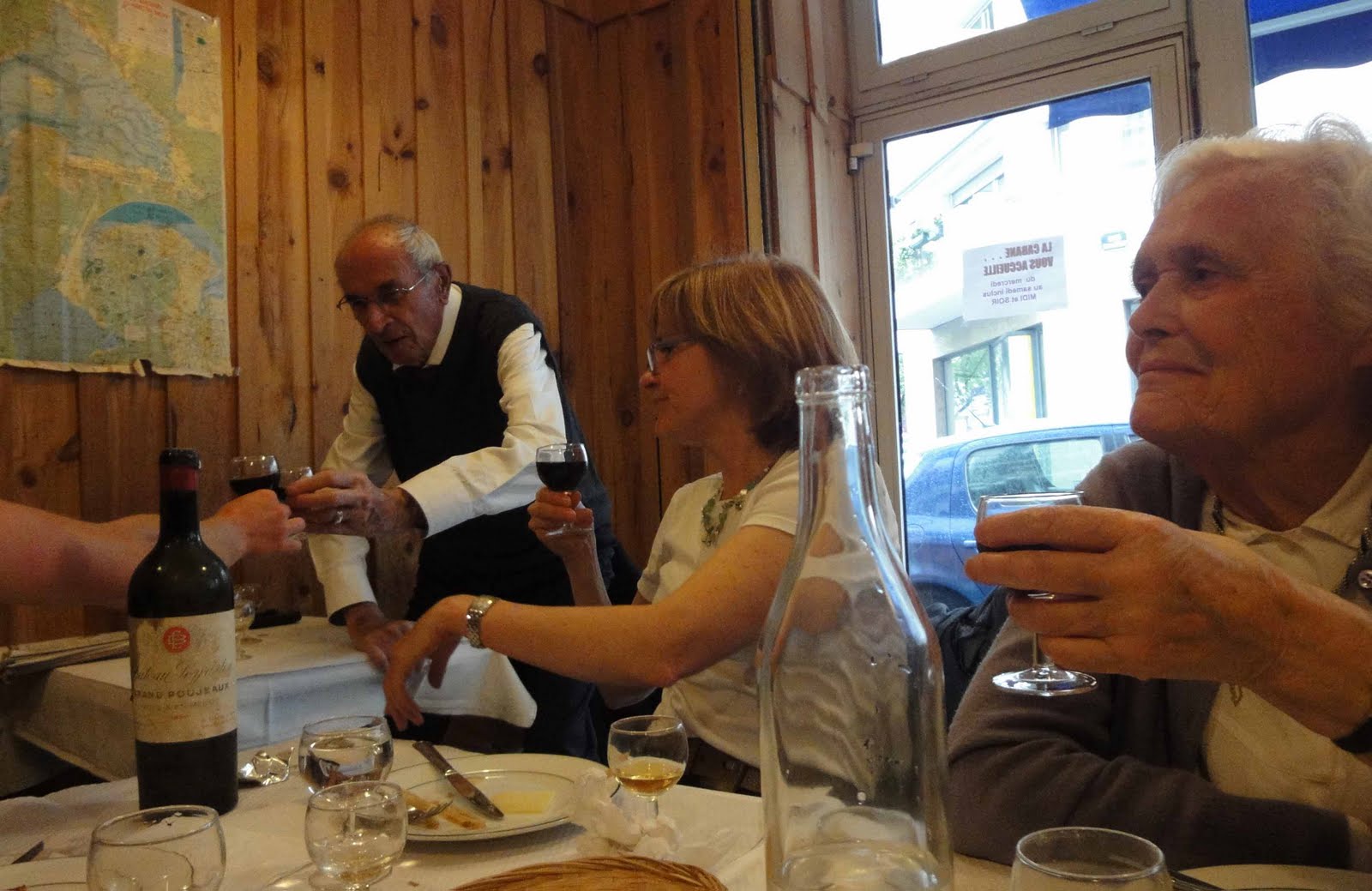
I celebrated my birthday again yesterday in Paris surrounded by friends old and new. We went to La Cabane à Huitres to eat more oysters, foie gras, cheese, dessert, and some very very special wine.

Here we are starting out with our oysters:

That's Eleanor Beardsley, NPR correspondent on the left, Odette Lefevbre, my Parisian friend of 35 years, and me.

After the oysters, we moved on to foie gras accompanied by a 1971 Sainte Croix du Mont (a sweet white Bordeaux wine that goes particularly well with foie gras).

After the foie gras, we had cheese - a brebis (sheep) cheese from the Pyrenees. And to go with the cheese, Francis opened a very very special bottle of wine - a bottle of Medoc from the year I was born!


Francis actually opened the bottle of wine ahead of time: the rule of thumb is one hour for every year . . .


The wine was DELICIOUS! Everyone in the small place joined us for a toast!


That's Monsieur Ponce in the background - he is the 96 year old regular that I've mentioned before.

A wonderful time was had by all!


Special thanks to Francis for the gracious gift of a very special wine. And thanks to Lauren and Odette and Emma and Julie and Eleanor (who had to leave early to work) for helping make this a very special occasion for me!

Thursday, May 13, 2010

La Cabane a Huitres - again!

I went to the Cabane a Huitres twice this week. I went by myself on Thursday, my laptop computer in hand so that Francis could listen to an NPR article by Eleanor Beardsley on January 1st, 2007 featuring him.

When Francis learned that I was American a couple of weeks ago, he immediately trotted out an envelope from NPR with a letter and CD recording of the program. Unfortunately, Francis doesn't have a computer so he hasn't been able to listen again to his program.

I promised to bring the computer, along with a printout of the transcript, and Eleanor's contact information. You can hear the story for yourself here:
Here is my own photo of Francis shucking oysters:


I went again on Friday. But not alone this time. My friend Colleen from Boulder had to come to Paris on business. She and Lisa came early for a mini vacation. When Colleen arrived, she reminded me how much she loves oysters, having grown up on the East Coast. She has also been following my blog, and of course I wanted to introduce her to Francis and his oysters. Here is a photo of Colleen and Lisa:


I realized this morning that all of these oyster stories are not just about the oysters. Nor are they about Francis and his Cabane a Huitres. For me, oysters are inextricably linked with Charlie and our 40 years together. We both grew up in landlocked Colorado and never imagined eating something so foreign. We discovered them together and the story of our romance is interwoven with stories of oysters. Perhaps if I stay here long enough, I can create a new story about oysters - one that doesn't have Charlie in it.

Friday, April 30, 2010

La Cabane a Huitres

I think I'm addicted. I returned to Paris on Thursday night and then moved into a new apartment in a different neighborhood on Friday morning just before noon. Formalities aside, I didn't even unpack before deciding that it was lunchtime. Where to go for lunch? Where else?! My favorite oyster place is no longer within walking distance, but it is a direct Metro ride.

When I arrived, all of the tables were occupied. No matter, Francis the owner motioned to a table by the door where one of the regulars was sitting. (It turns out that the majority of the patrons are regulars!) The 96 year-old monsieur was there too . .

When I first sat down in the crowded space, I jostled the table and spilled a few drops of one fellow's red wine. After a little bit of grumbling, things settled down and the oysters started arriving and the wine started flowing. Because it is such a small place, they often leave the bottles of wine on the table and you can serve yourself. This is not the kind of place where they measure every ounce that you consume!

My oysters disappeared quickly:


This could be very habit forming! I've never eaten such fresh oysters at such a good price in such a friendly ambiance. I'm sure I'll go back there next week . . . They are only open from Wednesday to Saturday, lunch and dinner. I suspect I'll see many of the regulars again.

Wednesday, April 7, 2010

More oysters

Did I mention that the apartment in the Passage d'Enfer is within walking distance of the oyster place that I discovered? I went there for lunch for the third time today. Yummmmmm. Even better, the place is so small (16 seats fully occupied) that I now feel like a regular. When I went there last week, it wasn't too busy so I learned a lot more about the place and its regular customers, including one 96-year- old gentleman who comes in regularly. This week, the owner, Francis, welcomed me back with a handshake as soon as I arrived. There is no menu and no wine list, so as soon as you are seated they bring over a bottle of white wine and start opening oysters. Of course, they know the habits of the regulars, with some immediately starting with red wine as an aperitif. Here is the inside of the restaurant:


Here is Francis, the owner, and Ségolène. At first I thought Ségolène might be a family member, but no, "I'm just the server" she insisted:


This week, after my 14 oysters and two (small) glasses of white wine, I had a smoked magret de canard (duck breast) with red wine instead of the foie gras. It was delicious! Here's what it looked like: (oops, I took a couple of bites before I remembered to take a picture!)


p.s. To all my oyster loving friends - I'm sorry you aren't here to enjoy them with me!