Why this blog?

To understand why this blog was created and where it got its name, start here
Showing posts with label architecture. Show all posts

Wednesday, February 26, 2014

Futuroscope

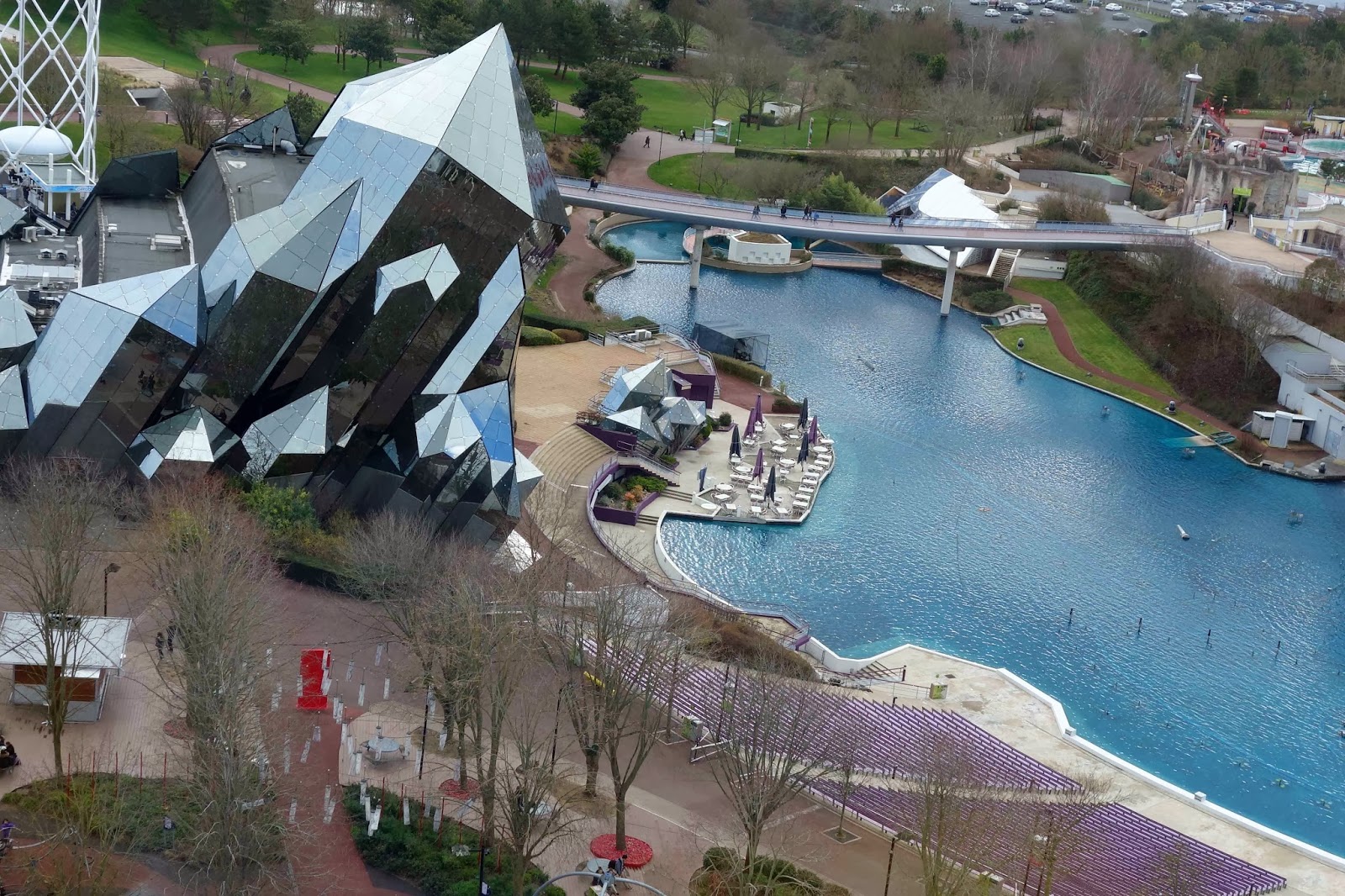
Futuroscope is a French theme park featuring several IMAX 3D and 4D cinemas along with other attractions and shows. Patrice and I bought a two-day ticket to the park which is located about three hours south of Paris. I was interested in photographing the futuristic architecture which we'd seen several times from the highway,


but we weren't sure if the rides - such as the Lapins Crétins (Raving Rabbids (sic)  and their time machine - might be somewhat childish.

But no. We had a great time! We laughed a lot as we were strapped into seats and then subjected to rapid twists, turns, puffs of air and water splashing in our faces as we hurtled through a 3D universe.
Dancing with robots
We also enjoyed the Aerobar where we drank a beer with our feet dangling 100 feet in the air.


What a great view from up above!
I loved the colors after dark, too.

Monday, December 30, 2013

Frank Gehry in Paris

The Fondation Louis Vuitton commissioned architect Frank Gehry to create a building designed to showcase its collection of modern art and to provide a platform in Paris for twenty-first century art and culture.

The exterior of the building with its 13,500 m2 of curving glass panels has just been completed, although the interior will not open to the public until autumn, 2014.

Weather conditions were perfect yesterday afternoon for a photo-visit. I thought my architect-daughter-in-law Rachel would enjoy seeing some pictures.
 The building is located next to the Jardin d'Acclimatation in the Bois de Boulogne. Gehry imagined a "glass sailing ship" that would reflect the natural beauty of the forest.

A technology marvel. And one that will surely become an icon in the years to come.

Tuesday, April 16, 2013

Le Corbusier

On Sunday we visited one of Le Corbusier's iconic works, the Villa Savoye. Built between 1929 and 1931 as a weekend home for the Savoye family, it illustrates the "Five Points of New Architecture."

Stilts
By using stilts (pilotis), Le Corbusier created a "box in the air" construction with its base disappearing into the surrounding grass.

Roof Gardens

The flat roof becomes a useable terrace where flowers can be planted. The horizontal line of the building means it stands out clearly against the sky.

Open-plan

Reinforced concrete frees the interior of load-bearing and separating walls. The posts support the floors, allowing for an open-plan design. Light partitions are sufficient to separate the different areas.
 Free-floating facade

The facades were free of the load-bearing structure, and placed freely on the stilts. Their positions are determined by the views from the inside.
 Horizontal window

The non-load-bearing facades can have long windows, creating light and airy interiors, two qualities which were highly prized in the Modern movement.

  Paradise for photographers!


Tuesday, October 2, 2012

Clyfford Still

We have eclectic tastes. When we're not rising before dawn to watch the elk, or attending a model airplane rally (photos coming soon), we like to visit art museums. I learned of a new museum in Denver which houses the entire collection of the American abstract expressionist painter Clyfford Still.

Still's early work (1930s) is representational and the museum points out influences and similarities with the work of Van Gogh.
Clyfford Still self-portrait 1940

The monumental later works are pure examples of abstract expressionism.
The Clyfford Still Museum is right next door to another of Denver's Art Museums.
Art comes in many forms.


Thursday, March 29, 2012

La Défense

Monday was a perfect day for a photo expedition - warm weather and a crystal blue sky. We decided to check out a more modern side of Paris - the area known as La Défense.
The building above is called the Grande Arche. It lies in a continuous line from the Louvre, west through the Tuileries, the Champs Elysées, and the Arc de Triomphe.

Looking west:Looking east - you can see the (tiny) Arc de Triomphe in the very center in the distance.The area has some interesting modern architecture. I call this the flying saucer building:
And some interesting sculpture. . .

Tuesday, January 4, 2011

Amateur photographer

I went out early this morning hoping to see and photograph the eclipse of the sun visible from Paris. A serious photographer would have carefully plotted viewpoints, camera angles, and timing. I neglected to do that. I did check for cloud cover, and got an early start. However, I'm not exactly sure where to look for the rising sun (my windows face west and I know all about sunset, but not sunrise). The task is complicated by the tall buildings all around here. So I ended up wandering east, eyes on the sky, looking for breaks in the buildings and in the clouds.

I never did see the sun or the eclipse - too many clouds. But I did end up in a neighborhood I'd never visited before. I found a couple of parks full of rhododendrons, azaleas, and cherry trees, and vowed to come back when they're flowering. I also stumbled on this church. It's called Notre Dame de l'Arche d'Alliance. It was designed by the same architects that created the Institut du Monde Arabe (more on that one later).


Front doors:


Closeup of exterior walls:


P.S. Did I mention that my daughter-in-law Rachel is an architect? So I often think of her when stumbling on unique structures such as this.